Claude Opus 4.8 Turns Coding Agents Into A Budget Decision
Claude Opus 4.8 adds stronger coding claims, dynamic workflows, Fast Mode, and effort controls. Here is how teams should route the upgrade.
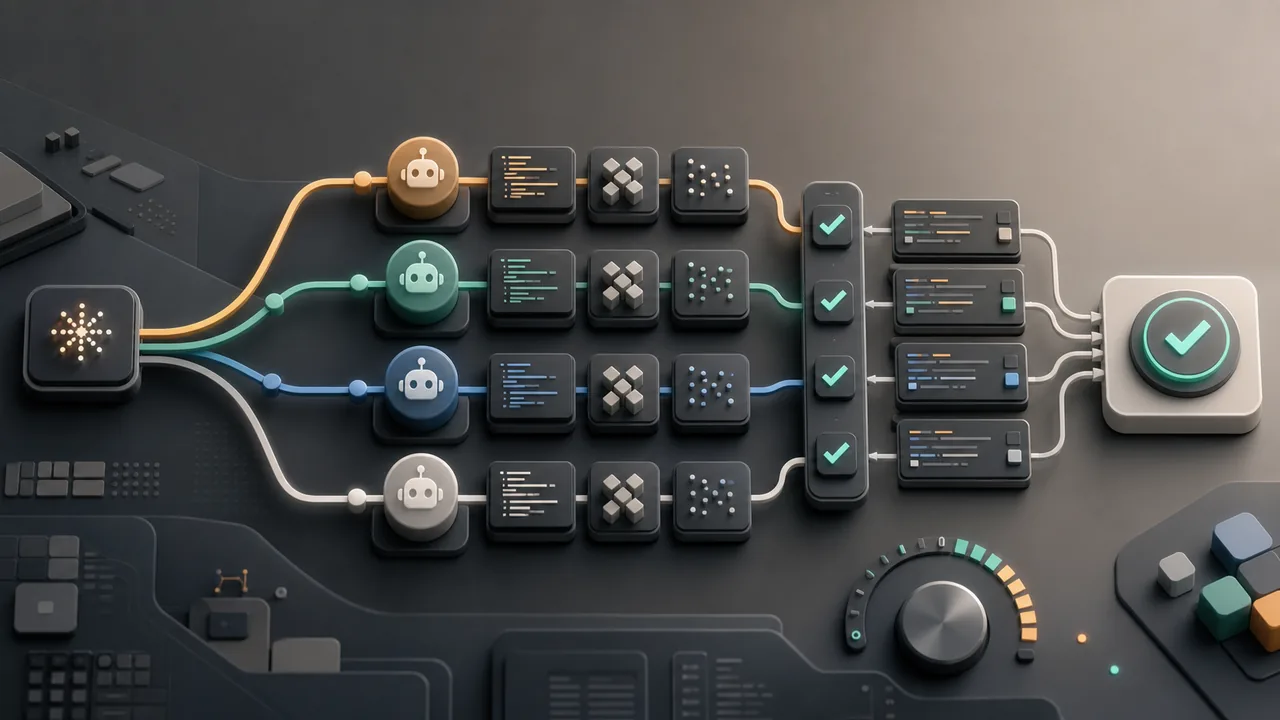
Updated May 29, 2026. Anthropic's Claude Opus 4.8 release is easy to describe as another model upgrade, but the more important change is operational. The company is not only saying the model is better at long coding tasks. It is also exposing more knobs around effort level, speed, price, context, and multi-agent work.
That makes the release useful for teams only if they treat it like a workflow decision, not a simple "use the newest model" switch.
The public interest signal is strong enough to watch. The Hacker News discussion for Anthropic's announcement was on the front page on May 29 and showed more than 1,300 points and more than 1,000 comments when checked. That is not proof that the model is better than a team's current setup. It is proof that developers are paying attention to agent cost, review quality, and how much autonomy to give coding tools.
What Opus 4.8 Is Actually For
Claude Opus 4.8 is a high-end Anthropic model aimed at difficult agent work, coding, and computer-use tasks. Anthropic frames it as an upgrade over Opus 4.7, with improvements across benchmark and internal evaluation results, including Terminal-Bench and OSWorld-Verified. The company also says the new model is less likely to let flawed code pass without comment. The model is available across the Claude app, Claude Code, the Anthropic API, Amazon Bedrock, Google Cloud Vertex AI, and Microsoft Foundry.
The rollout is more than the model card. Anthropic also announced dynamic workflows for Claude Code, a research preview that can spin up and coordinate many subagents during long tasks. The same release adds a Fast Mode, all-plan effort controls, and API support for system messages inside the conversation flow.
The decision rule is blunt: use Opus 4.8 where the cost of a bad merge, missed edge case, or confused refactor is higher than the extra model spend. For routine edits, first-pass cleanup, and tasks with narrow tests, a cheaper or lower-effort route may still be the better default.
What Anthropic Released
Anthropic's announcement says Claude Opus 4.8 is generally available and keeps the same regular Opus price: $5 per million input tokens and $25 per million output tokens. It also lists a Fast Mode priced at twice the standard Opus price. Anthropic says that Fast Mode is meant to be faster and is cheaper than the prior fastest Opus option, but it is still a premium path.
For API planning, Anthropic's model overview lists the model ID as claude-opus-4-8. The same documentation says Claude 4.6-generation and later model IDs use dateless pinned formats rather than evergreen pointers. It shows a one-million-token context window for most supported platforms and a 200,000-token context limit on Microsoft Foundry. The same page lists a maximum output size of 128,000 tokens.
Those numbers matter because agent workflows can quietly become large-token workflows. A tool that reads an entire codebase, opens logs, launches subagents, keeps task memory, and writes review notes can spend tokens in places a simple chat prompt never touches.
The announcement also says the Messages API can now accept system entries inside the messages array. That detail is small on the surface, but useful in real workflows. A team may want one instruction for exploration, a stricter one before editing, and a final one before review without restarting the whole task.
The Real Workflow Change Is Dynamic Workflows
The more interesting product change is in Claude Code. Anthropic describes dynamic workflows as a research preview for Max, Team, and Enterprise customers using Claude Code through the CLI, desktop app, or VS Code extension, with API and cloud-platform access also listed. The Claude post says Max and Team users, and API users, have the feature on by default. Enterprise has it off by default at launch, with admins able to enable it.
Instead of running one agent through a long task, Claude can create and coordinate subagents as the job expands. Anthropic says Claude Code may launch tens or even hundreds of agents for complex work, using them for research, implementation, debugging, verification, or other parts of the task. The feature also changes the mental model of "ask an assistant for code" into something closer to a temporary engineering swarm managed by the model.
That does not make it magic. It makes the oversight problem sharper.
For a developer maintaining a mixed frontend and backend app, dynamic workflows could help split a migration into discovery, test repair, API contract checks, and UI cleanup. But the final question is not whether many agents ran. It is whether the result still passes through the team's normal merge discipline: tests, review, diff inspection, ownership boundaries, and rollback thinking.
That is why this is a narrower follow-up to GearBriefly's earlier look at slower AI coding review workflows and GitHub Copilot's coding-agent handoff. The question here is not whether agents can write code. It is how much effort, budget, and autonomy a team should attach to each class of coding task.
Effort Is Now A Budget Control
Anthropic says effort controls are available across all plans. Standard mode now uses high effort by default, and the Claude apps expose extra settings such as xhigh and max for harder problems. Lower effort can reduce token use and improve responsiveness; higher effort gives the model more room for complex reasoning.
This is where teams need a policy, not a vibe.
Use lower effort for:
- Renaming, formatting, or narrow cleanup with strong tests.
- Explaining unfamiliar code before any edit happens.
- Drafting issue summaries, release notes, or simple migration notes.
- Trying a disposable prototype where correctness is not yet the bottleneck.
Use higher effort for:
- Cross-file refactors where hidden coupling is likely.
- Security-sensitive changes, auth flows, data retention logic, or billing logic.
- Test repair where a quick patch could hide the real failure.
- Tasks where the model must compare docs, code, logs, and previous decisions.
- Final review before a change touches production.
The real risk is not paying more for the hard task. The real risk is using a cheap, fast path for work whose failure cost is much higher than the token bill.
A Rollout Table For Teams
| Work type | Better starting mode | Why |
|---|---|---|
| Small copy, docs, or formatting change | Lower effort or cheaper model | The work is bounded and easy to inspect. |
| New feature behind a flag | Standard Opus 4.8 with normal review | The agent can reason across files, but the blast radius should stay controlled. |
| Large refactor, flaky test investigation, or dependency migration | Higher effort Opus 4.8 plus explicit test plan | The model needs room to inspect causes instead of patching symptoms. |
| Long multi-area codebase task | Dynamic workflows only with tight scope and review checkpoints | Subagents can parallelize discovery, but they also multiply output to verify. |
| Production incident, auth, payments, privacy, or data deletion logic | Human-led workflow with Opus as assistant and reviewer | The model can help, but accountability and verification cannot be delegated. |
This is a healthier way to adopt the model than turning it on everywhere. Route the task first, then choose the model and effort level.
What To Verify Before Switching
Before putting Opus 4.8 into a default coding path, check five things.
First, confirm where the model is available in your stack. Anthropic lists broad availability, but platform limits differ. The context window example is the obvious one: Microsoft Foundry is listed with a smaller context window than Anthropic's own API, Amazon Bedrock, or Google Cloud Vertex AI.
Second, decide whether Fast Mode is actually needed. Anthropic prices it above standard Opus. If the work runs in the background and waits for review anyway, lower latency may not justify the extra cost. If the agent is inside an interactive debugging loop, speed may matter.
Third, separate "can launch subagents" from "should launch subagents." Dynamic workflows sound attractive for large jobs, but they also create more intermediate claims, assumptions, and generated patches. A repo with weak tests may get busier before it gets safer.
Fourth, keep final review outside the agent's own enthusiasm. Ask for the evidence: changed files, tests run, unresolved risks, assumptions, and any area skipped. If the agent cannot name what it did not verify, the review is not finished.
Fifth, watch token spend by task type. A one-million-token context window is useful, but it can also hide waste. Track which prompts consume the most tokens, which ones produce accepted patches, and which ones still need heavy manual rewrite.
What Not To Overread
Anthropic's own benchmarks are useful signals, but they are not your production environment. Terminal-Bench, OSWorld-Verified, and internal evaluation claims do not measure your code ownership model, flaky tests, brittle deployment scripts, undocumented business rules, or team tolerance for agent-written diffs.
The honesty claim also needs a practical reading. Anthropic says Opus 4.8 is less likely to let flawed user ideas pass without comment. That is valuable if it means the model pushes back on a bad migration plan. It is not a guarantee that the model will catch every missing test, privacy issue, or incorrect premise.
The same caution applies to long context. Bigger context helps only when the right material is included and the task asks the model to use it well. Dumping a large repo into a model without a clear target can create a polished answer that still misses the important file.
The better adoption pattern is incremental: start with a bounded workflow, compare results against your existing model route, keep human review mandatory, and expand only when accepted changes and review time justify the cost.
The Practical Conclusion
Claude Opus 4.8 is most interesting as a sign of where coding agents are going. The model is stronger, but the release also makes speed, effort, context, and agent orchestration more explicit.
For teams, that is good news only if the controls become part of the process. Pick the task class, choose the effort level, decide whether dynamic workflows are allowed, require evidence, and keep the merge gate human-owned.
The upgrade is not just "better Claude." It is a reminder that agent work needs a budget, a scope, and a review policy.